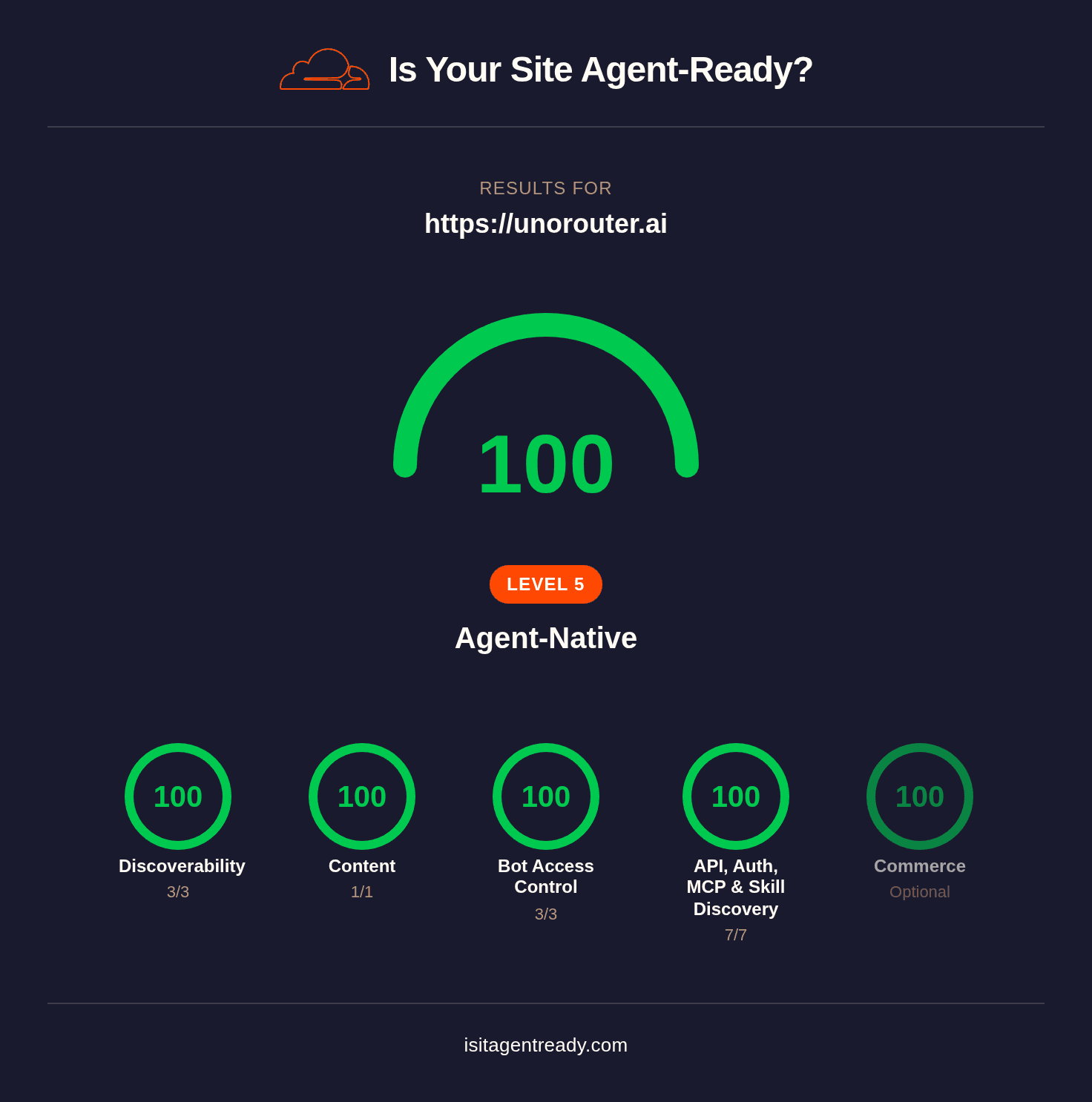
We pointed Cloudflare's agent scanner at our site. It came back 100/100.
Cloudflare just shipped a scanner that grades how ready your site is for AI agents. We hit a perfect 100/100 and the top Level 5 rating. Here is exactly what it checks and why most sites fail.
An AI agent walks up to your domain. Can it figure out who you are, what you offer, how to talk to you, and how to pay you? That is the question Cloudflare's Is Your Site Agent-Ready scanner tries to answer. We pointed it at unorouter.ai and got back a perfect 100/100 with the top-tier Level 5 Agent-Native rating.
The result
Five categories, all green. Discoverability 3/3, Content 1/1, Bot Access Control 3/3, API/Auth/MCP/Skill Discovery 7/7, and the optional Commerce category passing as well. As far as the scanner is concerned, every emerging agent standard it knows how to look for is in place on unorouter.ai.
What Is Your Site Agent-Ready actually checks
It is a free Cloudflare scanner that hits your domain and looks for the technical signals AI agents use to discover and interact with a site. Think of it as a checklist: robots.txt, sitemap, link headers, content-type negotiation for markdown, AI bot rules, MCP server cards, agent skill manifests, OAuth discovery documents, x402 payment headers, and several emerging commerce protocols. Each check is one small HTTP call against a well-known path or header.
Every check, in plain English
Discoverability covers robotsTxt (a robots.txt that parses), sitemap (a sitemap.xml the scanner can fetch), and linkHeaders (Link: headers that point at machine-readable manifests). Content covers markdownNegotiation (whether the site responds with markdown when an agent asks for it). Bot Access Control covers robotsTxtAiRules (explicit AI-agent allow/deny rules), contentSignals (Cloudflare's content-signals format) and webBotAuth (signed bot identity). API/Auth/MCP/Skill Discovery covers apiCatalog (a discoverable API listing), oauthDiscovery and oauthProtectedResource (RFC 9728 OAuth metadata), mcpServerCard (a Model Context Protocol server descriptor), a2aAgentCard (Google's Agent-to-Agent card), agentSkills (declared skill list) and webMcp (HTTP-bound MCP). Commerce covers x402 (the HTTP 402 payment standard), mpp, ucp and acp (three competing autonomous-commerce drafts). unorouter.ai answers correctly on all of them.
An honest disclaimer
These checks are simple stubs. The scanner mostly verifies that a well-known URL exists, returns a 200, and contains the right top-level shape. It does not run a real OAuth flow, it does not actually invoke an MCP tool, it does not settle an x402 payment. A green tick means the door is unlocked, not that the room behind it is finished. Anyone who depends on a protocol in production should still do their own end-to-end verification: round-trip the OAuth flow, call the MCP tool from a real client, run an x402 payment all the way to settlement. The score is a great signal that the surface area is in place. It is not a substitute for protocol-level conformance testing.
Run it on your own site
If you build anything that AI agents might one day touch, the scanner is genuinely worth a minute of your time. It surfaces a long list of small standards in one view and tells you exactly which well-known paths are missing or malformed. We use it as a regression check whenever we ship anything that touches discovery, auth, or commerce surfaces.
Scan your site at isitagentready.com, or if you came here for UnoRouter, grab an API key and start routing.
Over two days we wired 15 free providers into UnoRouter: 134 free model rows, one OpenAI-compatible endpoint, $0 per token. They are free for a reason and carry rate limits we cannot raise. Here is the honest version.
Link your account for $1, boost the server for $1 every month, hunt bugs for up to $50. We just opened the UnoRouter Discord.
Many image models advertise multi-reference editing, but availability across resellers varies wildly. We sent a fixed 6-image scene-composition prompt to every image channel in our catalog. 332 channel runs, 136 unique models, 54 with at least one verified passing provider.